Introduction
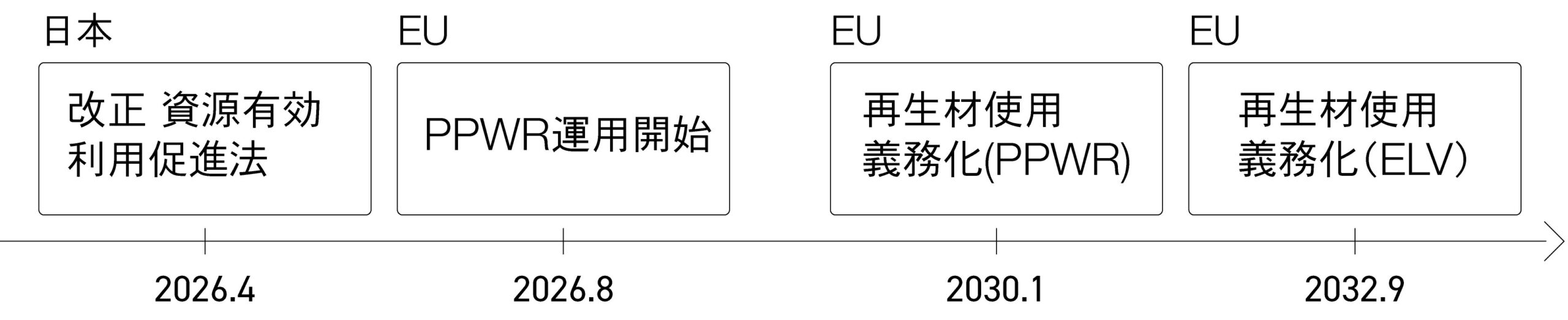
The transition to a circular economy has now become an indispensable theme for corporate survival strategies. In the EU, the PPWR (Packaging and Packaging Waste Regulation) came into effect on August 12, 2026, and the ELV (End-of-Life Vehicle Regulation) was also promulgated and enacted. In Japan, the revised Resource Recycling Promotion Act came into effect in April 2026, and the mandatory use of recycled plastics is beginning to move as a real issue.
"Environmental considerations" were once considered within the context of CSR and sustainability. However, now, a structure is emerging where "companies that can incorporate recycled materials gain a competitive advantage in the market." The adoption of recycled materials is a management issue that affects both the sustainability and competitiveness of a business.
Nevertheless, we continue to hear comments like these from those on the ground.
"We want to use recycled materials, but we can't find raw materials that meet our requirements."
"We are concerned about variations in quality, and therefore cannot obtain internal approval."
"I'm hesitant because I heard it's more expensive than virgin lumber."
Based on Pantech 's experience in plastic resource recycling for approximately 30 years, this article outlines the approach to realizing the introduction of recycled materials as a practical part of manufacturing.
Why do we need to use recycled materials now?
The mandatory use of recycled materials is not something limited to Europe.
In the EU, the PPWR (Plastic Plastic Waste Removal) will come into effect on August 12, 2026, and the use of recycled materials in plastic packaging will become mandatory from January 1, 2030. Further increases in the proportion of recycled materials are planned for 2040.
The ELV regulations were published and enacted on July 24, 2026, and from September 1, 2032, new cars will be required to use at least 15% recycled plastic (of which 20% must be from scrapped vehicles) in their plastic parts, and from September 1, 2036, at least 25% recycled plastic (of which 20% must be from scrapped vehicles).
In Japan, the revised Act on Promotion of Effective Utilization of Resources will come into effect in April 2026, and a system will be put into place from fiscal year 2027 onwards that will mandate the formulation and submission of utilization plans for containers, packaging, home appliances, and automobiles.
Another aspect that cannot be overlooked is the "procurement competition" aspect.
Unlike virgin materials, recycled materials have a limited supply. With demand expanding due to stricter regulations, the recycled materials market is already entering a stage of intense procurement competition. The longer you delay taking action, the narrower your options will become. It is no exaggeration to say that how you build a recycled materials procurement scheme will directly impact your company's competitiveness going forward.
Is it true that recycled materials are expensive?
For many companies considering introducing recycled materials, the first obstacle they encounter is cost.
"Virgin tuna is the upper limit for price. Anything above that won't get approved internally."
These are common concerns heard in procurement. Indeed, the supply chain for recycled materials is long and involves many steps such as collection, sorting, and processing, which often gives the impression that it is expensive.
However, the reality is different. In the logistics, construction, and horticultural sectors, recycled materials have been used as part of cost reduction measures long before sustainability became a major focus. Recycled materials that can be supplied at the same level as virgin materials, or even at a lower price, already exist on the market.
On the other hand, there are recycled materials that cost more than virgin materials. Examples include chemically recycled materials that have obtained ISCC PLUS certification and materials derived from ocean-bound plastics (OBP). Are these materials "too expensive"?
That's not necessarily true. It has value as a material because its supply chain is clear and it demonstrates a company's stance to stakeholders. We're moving from an era of "using it because it's cheap" to an era of "using it as a strategy." The fact that recycled materials are chosen despite their higher price is symbolic of this shift.
How to deal with "variation in quality"
The next concern frequently raised regarding the introduction of recycled materials is the stability of quality.
Recycled plastic raw materials tend to exhibit more variation in physical properties and color from batch to batch compared to virgin materials derived from petroleum. This tendency is particularly pronounced in post-consumer materials.
Whether you avoid this "fluctuation" as a "source of uncertainty" or embrace it as a "starting point for new value," the difference in attitude will greatly affect the quality and speed of the implementation process.
A practical approach is to start with parts that are more susceptible to quality fluctuations, such as internal structural components and auxiliary parts. Instead of focusing on areas directly related to appearance or brand image, start small, gradually expand the scope of application while accumulating experience and knowledge. We believe this process is an honest and rational way to adapt to change while cherishing our manufacturing culture.
The essence of using recycled materials lies in incorporating "what to protect and where to allow for adjustment" from the design stage.
Introducing recycled materials starts with a "management decision."
Companies that are making smooth progress in introducing recycled materials tend to start their discussions not on "cost" or "physical properties," but on their management vision of "what kind of circular economy scheme we want to create for our own company."
Setting a goal such as "converting 30% of our raw materials to recycled materials by 2030" is a valid starting point, but it's not enough. It's crucial to position the introduction of recycled materials as a "company-wide decision-making matter" and create a roadmap while sharing it throughout the entire company.
The clearer the management's intentions, the more unwavering the decisions made on the ground will be, and the more steadily the process will progress. Introducing recycled materials is a technical issue, but it is also a management challenge that fosters a "culture of dealing with variations in quality."
Pantech will accompany you.
In the field of plastic recycling, there is still no established "map." How to collect raw materials, the reproducibility of processing, quality assurance systems, and supply schemes—these are all being tested and updated little by little on a daily basis at each site.
Companies that take the initiative to "draw their own map" rather than "wait for someone else to draw one" are more likely to turn change into an opportunity. Waiting for perfection is tantamount to postponing change.
Pantech has a comprehensive system in place, from collecting unwanted plastics to processing recycled materials, compounding, quality control, and supply, and has supported the introduction of recycled materials by many manufacturers and brands. We will work with you to create the optimal introduction and operation roadmap based on our unique database, while listening to your needs regarding application, required functions, procurement volume, acceptable quality fluctuations, and target price.
Our role at Pantech is to support the implementation of a sustainable recycled materials procurement scheme that actually works, rather than relying on idealistic theories. We encourage change on the ground.
Rather than eliminating the "variations" in recycled materials, we should understand, accept, and transform them into value. We believe that the companies that can truly realize resource recycling are not those that "find" recycled materials, but those that can "update their values."
Pantech will walk alongside you on that journey.
See you at the exhibition!
Please feel free to discuss the topics covered in this column, as well as any other questions you may have regarding the procurement and introduction of recycled plastic raw materials, at the exhibition.
This fall, Pantech will participate in the 6th Sustainable Materials Exhibition (SUSMA), marking its first exhibition appearance since its rebranding. Through our exhibit, which is based on the concept of "supplying the optimal recycled materials in the shortest possible time," you can see our strengths in high-quality recycled plastic raw materials and the quality control and stable supply that support our operations.
When you visit, please stop by booth number 35-31 . Our staff will be happy to assist you individually.
Free pre-registration for the 6th Sustainable Materials Exhibition SUSMA is open until Friday, September 4th. Normally, from Saturday, September 5th onwards, registration will require an admission fee of 5,500 yen (tax included).
However, we are issuing a free invitation badge (attendance pass) to everyone who registers using the button below.
We have secured a sufficient number of invitation badges, but quantities are limited.
If you are considering participating, please take this opportunity to register as soon as possible.
- Exhibition name
The 6th Sustainable Materials Exhibition SUSMA (part of High-Performance Materials Week)
- Exhibition period
Wednesday, September 30, 2026 – Friday, October 2, 2026
- venue
Makuhari Messe, 2-1 Nakase, Mihama-ku, Chiba City, Chiba Prefecture 261-8550
- booth
35-31
- Official website
Free pre-registration for the 6th Sustainable Materials Exhibition SUSMA is open until Friday, September 4th. Normally, from Saturday, September 5th onwards, registration will require an admission fee of 5,500 yen (tax included).
However, we are issuing a free invitation badge (attendance pass) to everyone who registers using the button below.
We have secured a sufficient number of invitation badges, but quantities are limited.
If you are considering participating, please take this opportunity to register as soon as possible.