


1. Why is it necessary to address PPWR now?
On August 12, 2026, the EU's new packaging regulation, the Packaging and Packaging Waste Regulation (PPWR), came into general application. This regulation completely replaces the old Packaging Waste Directive (94/62/EC), which had been in effect since 1994. While a "Directive" only becomes effective after being incorporated into national law by each country, a "Regulation" applies directly to EU member states. This reduces variations in interpretation between countries, but it also means that they will be required to act in unison without any leeway.
PPWR applies to all packaging "placed on the market" in the EU, regardless of whether it is manufactured within the EU or imported from a third country, including Japan. It does not matter if the packaging is empty or contains products. Packaging that does not meet the requirements cannot be sold in the EU market at all. This is not just a challenge for manufacturers of packaging materials, but also an issue that directly impacts the practicalities of procurement, such as selecting packaging materials and determining their specifications.
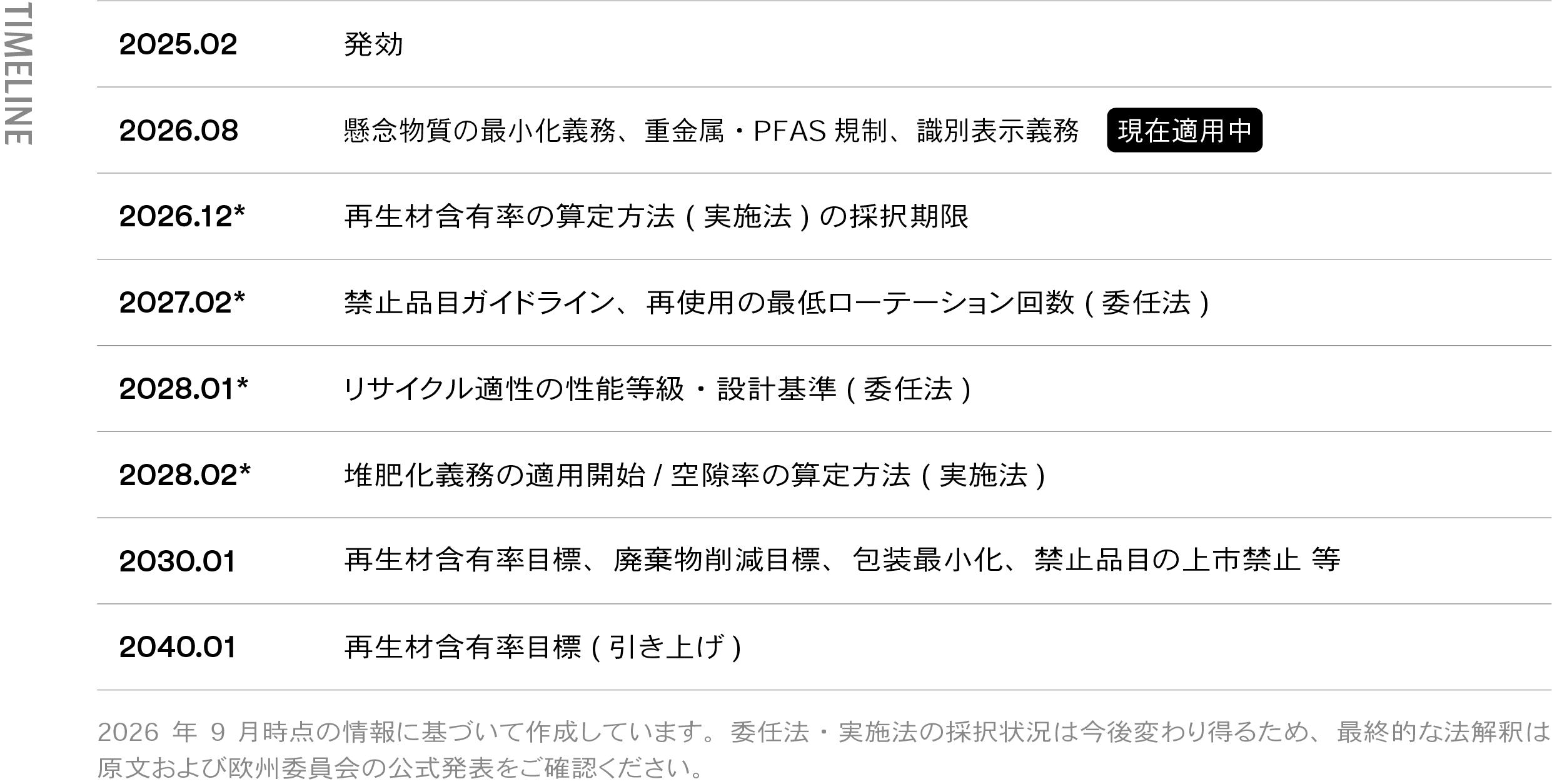
The main points that came into effect on August 12, 2026 are as follows:
● Mandatory minimization of substances of concern (SoC), total concentration of heavy metals (lead, cadmium, mercury, hexavalent chromium) below 100 ppm ● Limitation of PFAS concentration on food contact packaging ● Mandatory labeling of identification (serial number, lot number, manufacturer's name and address) ● Basic obligations as a manufacturer/importer (conformity assessment, DoC creation, technical documentation preparation)
However, the implementation date of August 12, 2026, does not mean that violations will immediately result in sales bans or penalties. First, a warning and opportunity for correction will be given, and only if correction is not made will measures such as sales bans and recalls be taken. The European Commission has also indicated a policy of "support over sanctions," so strict enforcement will not be implemented uniformly from the moment it comes into effect. Nevertheless, the fact remains that having a grace period does not mean that action can be postponed.
Many of you have likely already taken care of some of the obligations that have come into effect, but the remaining requirements will be gradually implemented from 2028 to 2030. In this column, we will reorganize the key points that businesses involved in plastic packaging should pay particular attention to, with an eye on the future.
2. What are the three key points that are effective for plastic packaging?
While the practical requirements for PPWR are numerous, the following three points are particularly important from the perspective of those dealing with plastic packaging:
(1) Regulation of substances of concern, heavy metals and PFAS
It is important to note that Article 5 combines three different types of regulations into a single article. First, regarding "Substances of Concern" themselves, there are currently no numerical concentration standards, and it is merely an obligation to "minimize their presence and concentration." However, the European Commission and the European Chemicals Agency (ECHA) are scheduled to publish a report by December 31, 2026, and it is possible that additional substances and specific thresholds will be added in the future.
Separately, there is an existing numerical standard (continued from the old directive) that limits the total concentration of lead, cadmium, mercury, and hexavalent chromium to 100 ppm (by weight) or less, and this has been in effect since August 12, 2026.
Furthermore, new restrictions on the concentration of PFAS (perfluorinated compounds) have been established for food contact packaging, and these have also been in effect since August 12, 2026. It is important to note that these restrictions apply regardless of whether the PFAS were intentionally added to the raw materials or accidentally mixed in, and that a comprehensive list of the PFAS subject to these restrictions will not be published.
(2) Recyclability
By 2030, all packaging will be required to be "economically viable to recycle." Specific design standards (Design for Recycling) will be established by a delegated law to be adopted by the European Commission by January 1, 2028. The direction is expected to focus on designs that are based on the recycling process, such as using single materials or structures that allow for easy separation of different materials.
The evaluation is categorized into grades A through C based on "how recyclable it is on a weight basis."
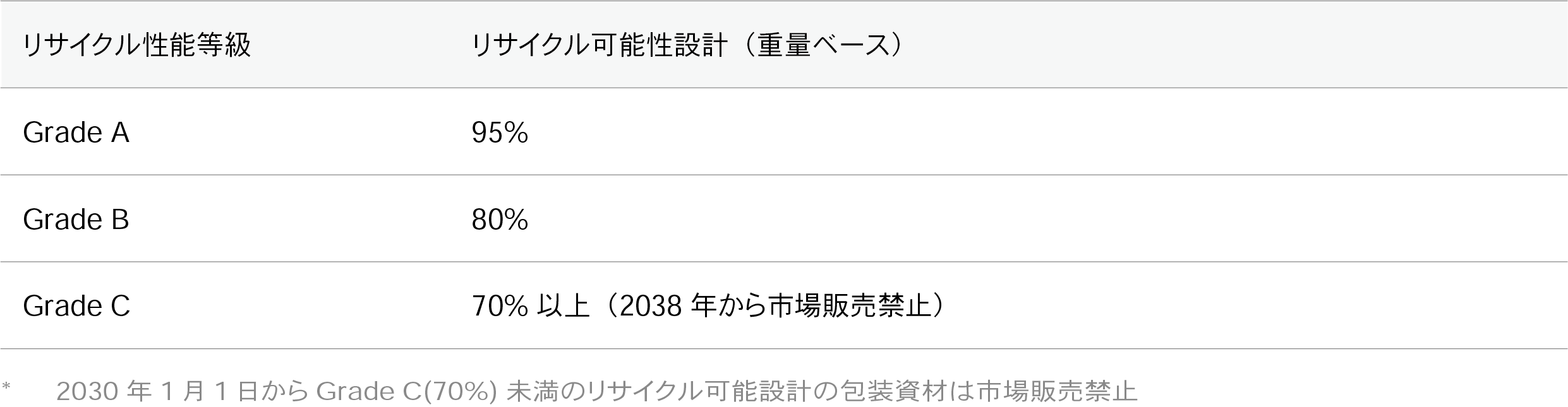
From January 1, 2030, only products of Grade C or higher (70% or more) will be allowed to be marketed, and from 2035, an assessment of "recycled-at-scale" (whether there is actually a scale of sorting and recycling within the EU) will be added. Furthermore, from 2038, Grade C itself will no longer be accepted, and only products of Grade B or higher (80% or more) will be allowed to be marketed. Note that there are exemptions for sales packaging made from cork, lightweight wood, textiles, and ceramics, but plastic packaging is not included in these exemptions.
(3) Content of recycled plastic materials
The target value for the percentage of recycled materials used in plastic packaging has already been determined. Here, "recycled materials" refers to PCR materials (Post-Consumer Recycled material) derived from waste materials used by consumers and end-users, and PIR materials (Post-Industrial Recycled material) derived from scraps and defective products generated during the manufacturing process within the factory are not included, even if they are recycled materials. Furthermore, the content rate is calculated as an annual average for each manufacturing site, not on a per-product basis.
The new regulations will come into effect on January 1, 2030, or three years after the implementation law specifying the calculation method comes into effect, whichever is later. The target values are categorized as follows, depending on the packaging's use (whether it is "contact sensitive" and comes into contact with food, pharmaceuticals, etc.) and material (PET or something else).
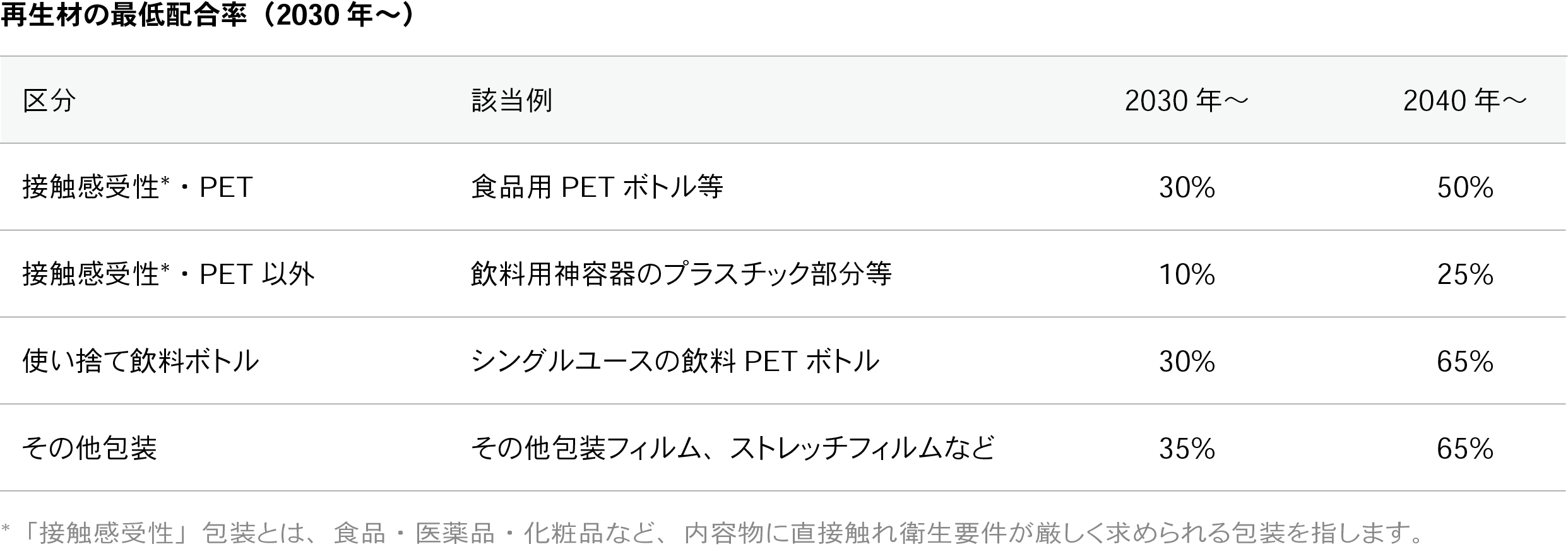
Packaging such as the stretch film handled by Pantech is classified as "non-contact sensitive (other packaging)," and by 2040, it will be required to contain a high level of recycled materials, exceeding 65%.
These three points are all directly related to the selection of raw materials and the design of the packaging itself. For the procurement department, which is responsible for designing the packaging specifications, these are points that cannot be avoided.
3. What is our company's position on the PPWR (Power Purchase Rate)?
When considering the practical implementation of PPWR, the first hurdle that people often stumble upon is "what is our company's position within PPWR?" If you proceed without clarifying this point, you will have difficulty understanding the paperwork and information gathering discussed in later chapters.
- The manufacturer is determined not by "who made it," but by "whose brand it is."
Under the PPWR (Product Protection Register), the "manufacturer" is considered to be the owner of the brand and trademark (the party with the authority to determine the packaging specifications), not the company that actually manufactured the packaging materials. This remains true even if the manufacturing itself is outsourced. Japanese companies exporting to the EU under their own brand will ultimately bear legal responsibility for conformity assessment, preparation of technical documentation, and creation of the EU Declaration of Conformity (DoC). For generic packaging that does not display the company name or trademark (such as plain cardboard boxes or stretch film), the company that actually manufactured it is generally considered the manufacturer.
- If you do not have a base in the EU, check whether you need an "authorized agent." An "authorized agent" is an individual or legal entity with a base in the EU that, with written authorization from the manufacturer, etc., handles some of the procedures under the PPWR on their behalf. For companies outside the EU, they act as a local point of contact for communication with EU authorities.
There are two types of accredited agents: agents for product conformity and agents for EPR (Extended Producer Liability), and they are treated differently. Agents for product conformity are appointed at the manufacturer's discretion. While they can be entrusted with tasks such as preparing declarations of conformity and dealing with authorities, they are not responsible for preparing technical documentation or assuming legal responsibilities as a manufacturer. On the other hand, agents for EPR may be required depending on the sales method and the member state.
- Differences from importers
If an EU trading company or agent sells the purchased packaging under its own private label, the importer is considered the "manufacturer," and responsibility shifts to them. A mere importer (who simply distributes the existing brand) is responsible for verifying the existence of the Document of Conformity (DoC) created by the manufacturer, storing it, and dealing with authorities, but the primary responsibility for conformity itself remains with the original manufacturer.
- Relationship with Producers (EPR Obligors) <br /> Separately from this, there is also the category of "producers" who are obligated to register and report under EPR (Extended Producer Responsibility). It is important to note that who is obligated to register for EPR differs depending on whether the product is sold directly within the EU or through a local agent. In addition, while measures have been put in place in each member state to simplify reporting for producers whose annual package weight is less than 10 tons, this does not mean that the EPR obligation itself is waived.
- Supplier's obligation to provide information
And most importantly from a practical standpoint are the obligations of packaging material suppliers. Article 16 stipulates that suppliers of packaging and packaging materials are obligated to provide the information and technical documentation necessary for manufacturers to demonstrate conformity. Since the enforcement of EU regulations (such as corrective orders and penalties) is mainly carried out through businesses within the EU, it is unlikely that EU authorities will directly enforce them against material manufacturers whose business is entirely confined to Japan. Nevertheless, manufacturers need to understand that this provision provides a legal foothold for tracing back certificates and data from upstream packaging material manufacturers.
Organizing this relationship will make it much easier to understand the practical issue of "who should prepare what," which will be discussed in subsequent chapters.
4. What should be kept in mind regarding prohibited items, void ratio, and reuse targets?
In addition to the three points mentioned above, it's also important to be aware of the points where people often stumble in practice.
- Prohibition of single-use plastic packaging (Article 25, Annex V)
Individual packaging of unprocessed fresh fruits and vegetables (weighing less than 1.5 kg, etc.), individual packaging of single-use cosmetics and hygiene products for hotel guests, single-use packaging of seasonings and preserved foods for HORECA (hotel, restaurant, and cafe) establishments, and ultra-thin plastic shopping bags (including biodegradable and compostable bags, excluding those for hygiene purposes or for bulk food sales) will be prohibited from being sold on the market from January 1, 2030.
- Reuse targets for transport packaging (Article 29)
For transport packaging such as pallets, collapsible plastic boxes, crates, and IBCs (medium bulk containers), from January 1, 2030, it will be required that more than 40% of all transport packaging be reused, with a target of 70% by 2040. Furthermore, transport packaging used for transport between locations of the same company or group, or for deliveries to other businesses within the same member state, will be subject to an even stricter requirement of 100% reuse.
However, there are exceptions to this 100% requirement. A delegated decision adopted on February 25, 2026, exempted stretch film and PP band from the 100% reuse requirement. On the other hand, it should be noted that these two items will continue to be included in the calculation of the general target of more than 40% reuse for all transport packaging.
Furthermore, the European Commission's FAQ clarifies that flexible transport packaging, such as flexible container bags, is also subject to reuse targets, unless it falls under an exception such as being used for direct contact with food or animal feed, or for transporting hazardous materials. Cardboard boxes, however, are not subject to reuse targets.
- Upper limit on porosity (Article 24)
For group packaging, transport packaging, and e-commerce packaging, the void ratio (the difference between the contents and the internal dimensions of the package) must be kept below 50%. It is important to remember that paper scraps, air cushions, bubble wrap, and polystyrene chips used as cushioning materials are also included in the void ratio.
- Mandatory minimization of packaging (Article 10)
The general principle of minimizing weight, volume, and number of layers will also apply from January 1, 2030.
What all these regulations have in common is that "the current usage amounts and specifications will no longer suffice." We should understand that we are compelled to reconsider the amount of cushioning material and film used, as well as the entire method of transport packaging, from the design stage onward.
5. How should we deal with things that haven't been decided yet?
In reality, many of the substantive requirements for PPWR (Potentially Recyclable Ware) are still not finalized. The design criteria for recyclability, the specific boundaries of what is prohibited in Annex V, the method for calculating void ratio, and the minimum number of rotations for reusable packaging—all of these will be determined by delegated legislation, implementing legislation, and guidelines that the European Commission will adopt in the future.
The approximate timing of the announcement is as follows:
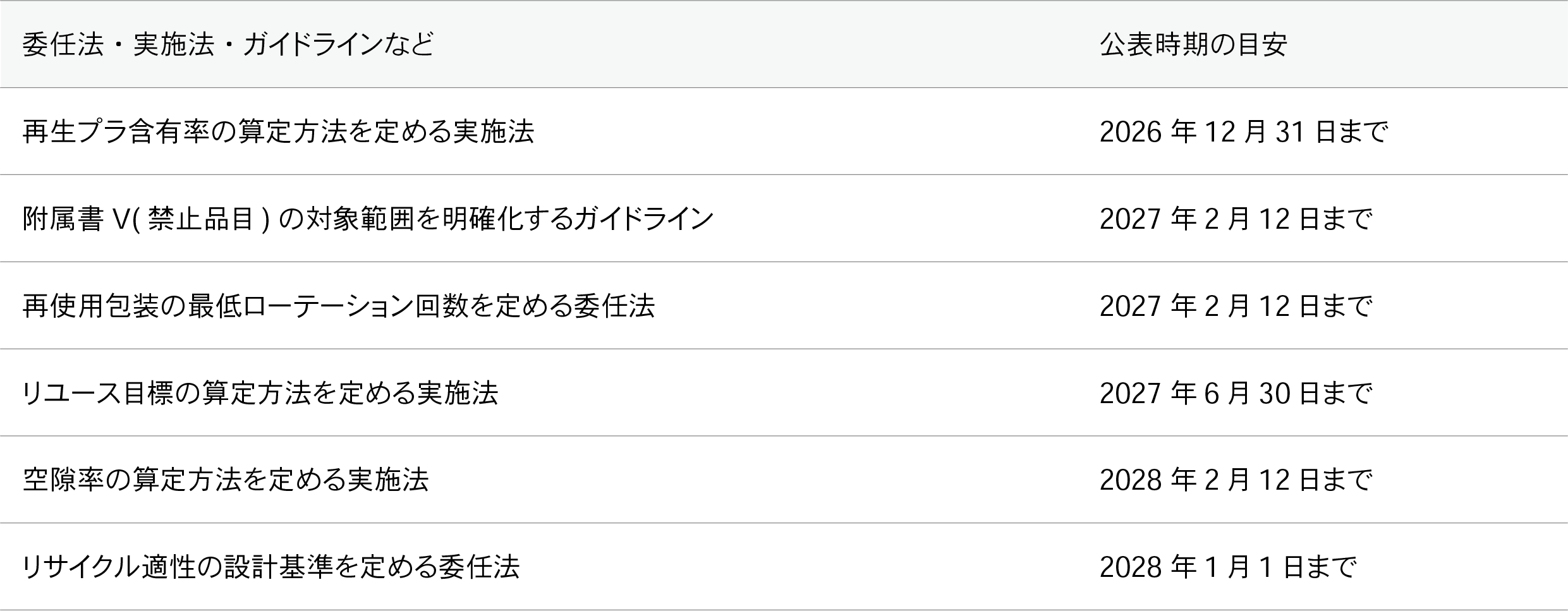
In other words, from the end of 2026 to 2028, a series of "answer key" checks directly related to the practical aspects of packaging design will take place. Rather than completely finalizing the specifications at this point, it seems more realistic to continuously monitor this publication schedule.
6. What is required for display and document support?
When discussing PPWR compliance, attention tends to focus on raw materials and design, but often the practical issues surrounding labeling and documentation are what truly trouble those involved in material procurement.
From August 12, 2026 onwards, packaging placed on the EU market will be required to include identification information such as serial numbers and lot numbers, as well as the manufacturer's name and address. The criterion for determination is the "date of market entry," not the "date of manufacture." For unmarketed stock manufactured before August 12, 2026, there is no need to discard or relabel it, and it is permitted to provide identification information in the accompanying documentation. However, this is not a uniform grace period that extends to other requirements; for example, there are no exemptions for PFAS regulations.
The EU Declaration of Conformity (DoC) must be prepared in the language of the Member State where the product is placed, or translated. Technical documentation must include a description of the packaging (format, use, function), drawings and specifications (layer structure in the case of multilayer materials), applied harmonized standards, conformity assessment results and risk analysis, test reports, and declarations of conformity or certificates from suppliers. Disposable packaging must be kept for 5 years, and reusable packaging for 10 years.
Ensuring such labeling and traceability is relatively easy with standardized packaging produced in large batches. However, for custom-made packaging tailored to specific uses and specifications, such as bags for parts, there are many types, and often multiple packaging material manufacturers are involved, leading to a significant increase in paperwork. Furthermore, any specification changes require updating identification information and technical documentation, which can drastically increase the workload. If this point is overlooked and only raw material changes are implemented, unexpected problems can arise. It is also important to consider reducing the number of packaging material items.
7. Why is it difficult to use PCR material in flexible packaging?
"Just switch to environmentally friendly packaging"—it's easy to say, but actually achieving that is not so simple.
As we saw in Chapter 2, the recycled plastic content will be increased in two stages, in 2030 and 2040. Aiming for 65% by 2040 all at once is quite a high hurdle. This is because stable raw material procurement, formulation design, and mass production systems cannot be established overnight. A more realistic roadmap would be to first set the relatively achievable level of 35% by 2030 as the immediate goal, and then use the procurement routes and molding know-how gained there as a foundation to gradually increase to 65% by 2040. Conversely, postponing the achievement of the 2030 target will mean losing time to reach the 2040 target.
Film products that claim to be "environmentally friendly" using recycled plastic raw materials or plant-derived biomass raw materials already exist on the market. However, PPWR requires PCR material. It is important to note that even if recycled materials are used, products made with PIR material are not eligible for PPWR.
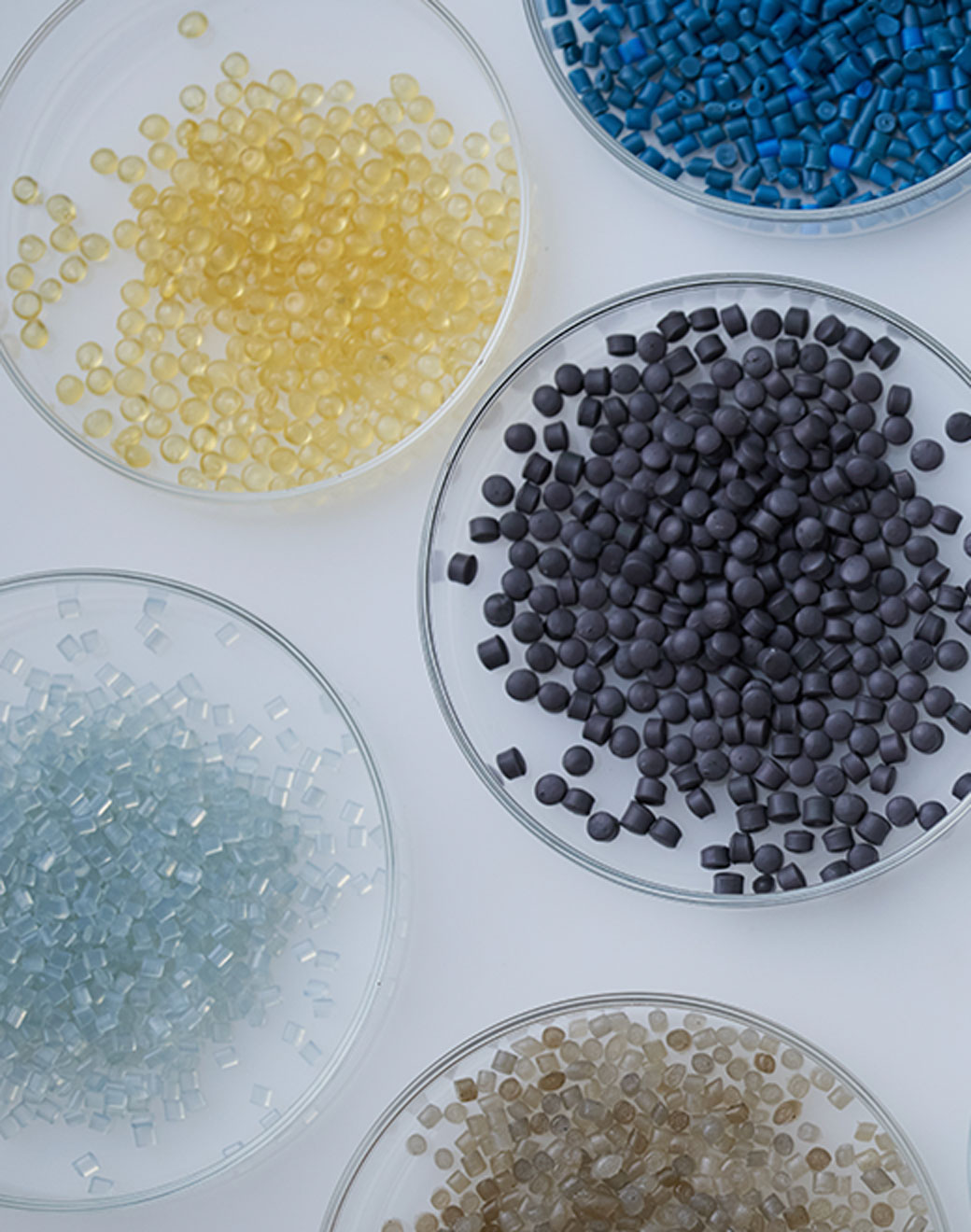
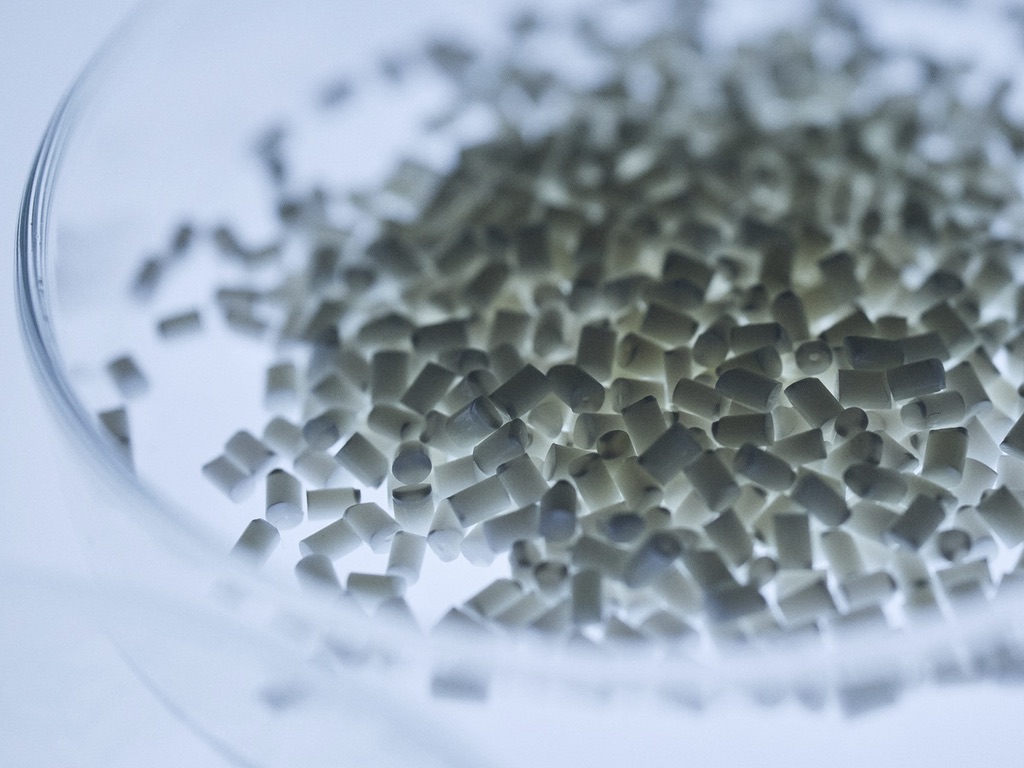
Mass-producing flexible packaging using PCR material is a different matter from creating flexible packaging from virgin material, which has stable physical properties and quality. PCR material derived from used products inevitably has a tendency to vary in quality. The origin and degree of deterioration of the collected products are not uniform, and in order to use the recycled PCR material from these products to create packaging materials of sufficient quality for practical use, flexibility is required to respond to the situation, from identifying raw materials to designing the formulation and adjusting the molding conditions. This requires more knowledge and experience than when working with virgin material.
A stable supply of PCR materials and effective utilization of those materials are both essential. Without establishing a system that can achieve both simultaneously, it will be difficult to meet the recycled plastic material content requirements set by PPWR. That's why it's crucial to start "now," working backward from 2030, to select suppliers, review specifications, and begin prototyping.
8. So, where should I begin?
Responding to PPWR involves multiple challenges, including clarifying our company's position, switching raw materials, adapting to labeling and documentation requirements, and continuously monitoring areas where specifications are not yet established. In particular, effectively using PCR materials in flexible packaging requires considerable knowledge and experience.
Finally, we have included a checklist outlining the key points to address going forward, so please use it as you proceed with your PPWR implementation.
□ Have you clarified whether your company is a manufacturer, importer, or producer (EPR obligor)? □ If you do not have a base within the EU, have you confirmed whether an authorized agent (product conformity and EPR) is required? □ Have you addressed the identification markings (manufacturer name, address, serial number) on packaging manufactured after August 12, 2026? □ Do you have prepared DoCs and technical documentation and secured a storage system (5 years for single use, 10 years for reuse)? □ Do you have a route for obtaining certificates and technical information from suppliers? □ Have you confirmed whether the packaging you handle falls under the prohibited items in Annex V? □ Do you understand the reuse target for transport packaging (40% overall) and distinguish between items subject to the 100% requirement (pallets, etc.) and those not subject to it (stretch film, PP bands)? □ Have you found suppliers who can meet the recycled material content targets (by category) for 2030 and 2040? □ Do you have a system in place to monitor the schedule of delegated and implementing laws to be published from the end of 2026 to 2028?
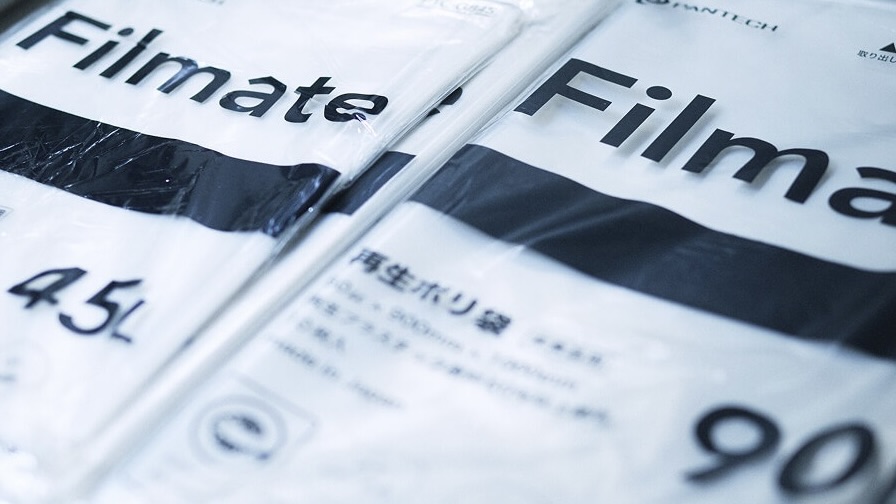
Pantech , we consistently handle Film to Film (horizontal recycling of film products) under our own brand "Filmate®," collecting used stretch film, returning it to recycled raw materials, and then designing, manufacturing, and delivering it back to the market as new film products.
By handling the entire process from the collection of used plastic products to their recycling into raw materials and subsequent remanufacturing, we can manage information regarding the origin and properties of recycled materials without interruption. This continuity of information is essential for the certification and technical documentation of recycled materials required by PPWR.
Based on the expertise gained with "Filmate®," Pantech offers custom-made products such as standard bags, resealable plastic bags, and pallet covers using PCR material, as well as handling recycled flexible container bags, recycled plastic pallets, and recycled PP bands.
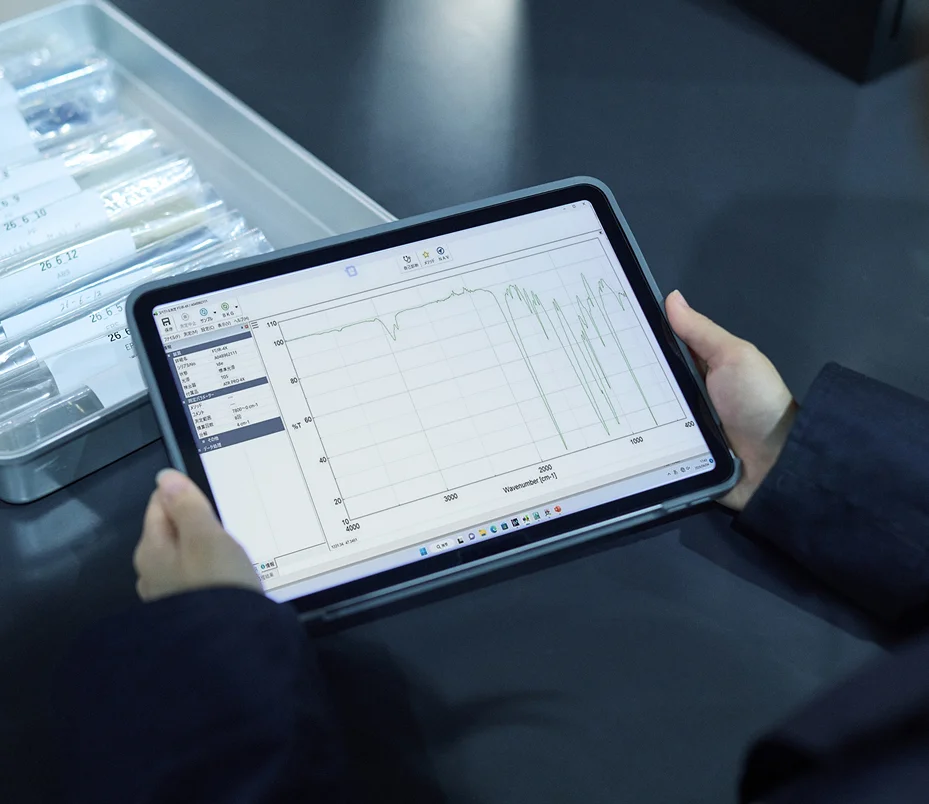
Furthermore, our own facility, the "Circular Design Center (CDC)," is capable of measuring the physical properties of recycled materials and heavy metals (lead, cadmium, mercury, hexavalent chromium), and we have established a system to provide various test data and material information.
From current situation analysis to improvement proposals and actual supply, Pantech provides comprehensive support for PPWR compliance in plastic packaging materials. Please feel free to contact us.
*This article is based on information as of September 2026. The adoption status of delegated and implementing laws may change in the future, so please refer to the original text and the official announcements of the European Commission for the final legal interpretation.